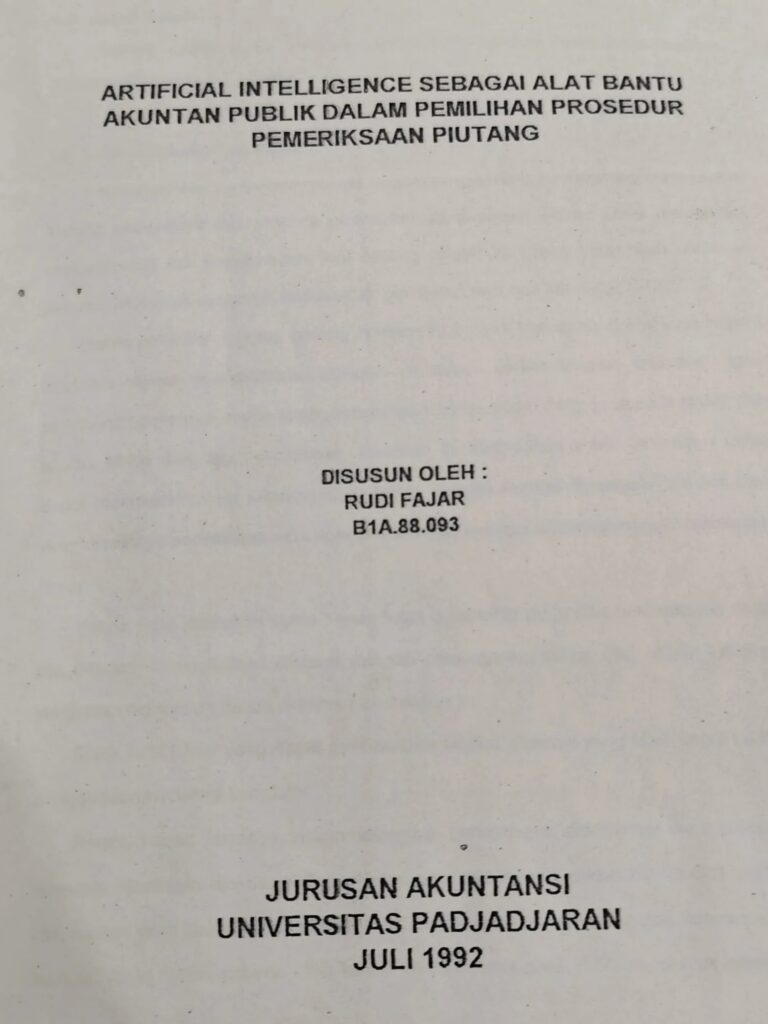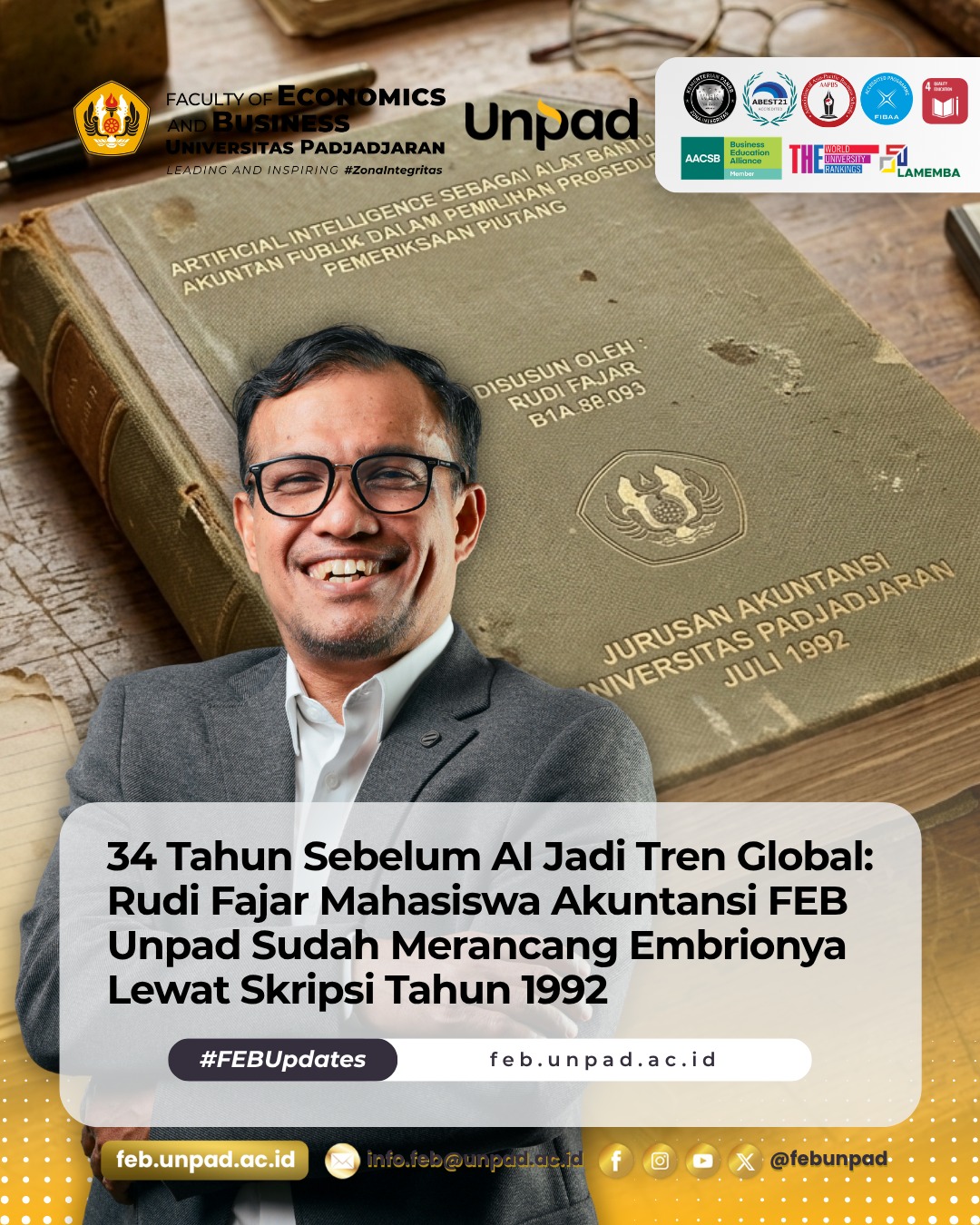
Bandung, FEB Unpad – Long before the internet arrived in Bandung and the term “artificial intelligence” (AI) became a household name, an Accounting student at Universitas Padjadjaran was already envisioning how AI could assist accountants in their future work.
That student was Rudi Fajar, an alumnus of the Bachelor of Accounting program at the Faculty of Economics and Business, Universitas Padjadjaran. In July 1992, Rudi completed his thesis titled “Artificial Intelligence as a Tool for Public Accountants in Selecting Receivables Audit Procedures.”
At a time when conventional accounting research dominated the field, his choice of topic was unconventional. Rudi’s interest in AI stemmed from a deep curiosity about technological advancements.
“I was young back then—full of curiosity and academic idealism, and above all, I felt challenged,” he recalls.
The inspiration struck while he was attending a Management Systems course. One of the English-language textbooks used in the class contained a brief discussion on artificial intelligence and expert systems.
“There was a paragraph that touched upon Artificial Intelligence, stating that the most advanced level of computer programming in the future would involve the use of AI and expert systems,” he said.
Despite finding limited references, Rudi decided to delve into the topic. The greatest challenge was the difficulty of obtaining literature; in the early 1990s, access to information on AI was extremely restricted.
“I couldn’t find the necessary references in Bandung or Jakarta. Since I was already committed to the idea, I looked for literature in Singapore and managed to acquire the two or three books I needed,” he said.
In his thesis, Rudi explored the use of technology to aid decision-making during receivables audits. He believed that the more comprehensive the available data, the higher the quality of the resulting information.
“I believed that if the data was extensive and complete, the information processing would be more thorough and accurate, while also reducing human error. The more data involved, the ‘smarter’ and more accurate the system would become,” he explained.
To bring this concept to life, Rudi collaborated with a fellow boarder who was an Industrial Engineering student at ITB. Using Clipper Summer ’87 software, they developed a simple program focused on the process of selecting samples for accounts receivable audits.
According to Rudi, the program he created certainly cannot be equated with the modern AI known today. However, the underlying concept shared a similar spirit: leveraging data and computer systems to assist human decision-making processes.
“Linking it to the current definition of AI would certainly be debatable. The program was more accurately an embryo or a precursor to AI,” he said.
He also acknowledged that the primary goal of his thesis was not to create perfect technology, but rather to convey a significant idea through a simple example that readers could easily grasp.
More than three decades later—with AI having advanced rapidly and found application across various fields, including accounting—Rudi Fajar’s story serves as a reminder that the courage to explore new ideas often marks the beginning of innovation. What was merely a concept and a nascent idea in 1992 has now evolved into technology that transforms how people work, learn, and make decisions.
For FEB Unpad, this story demonstrates that a spirit of visionary thinking—one that looks beyond the times—was already flourishing on campus long before AI became a global phenomenon.