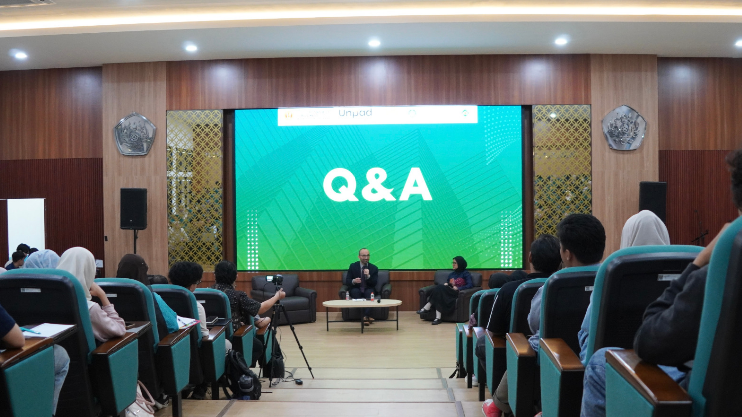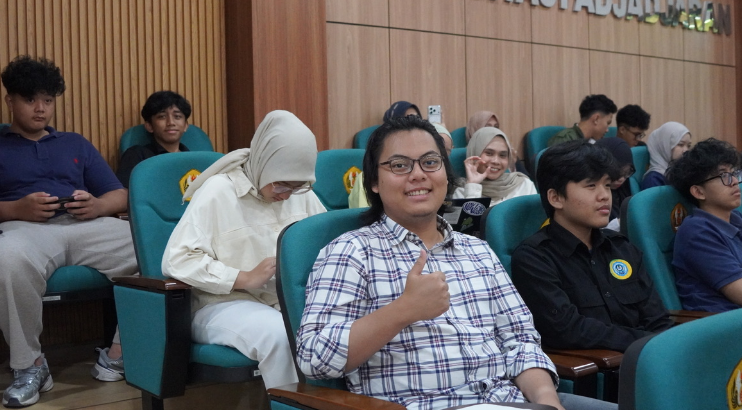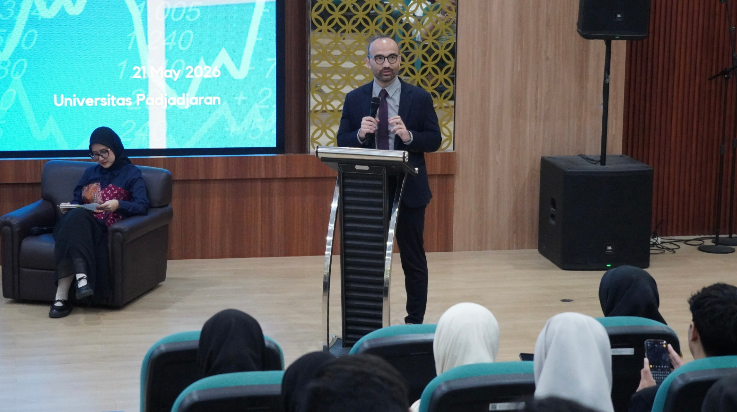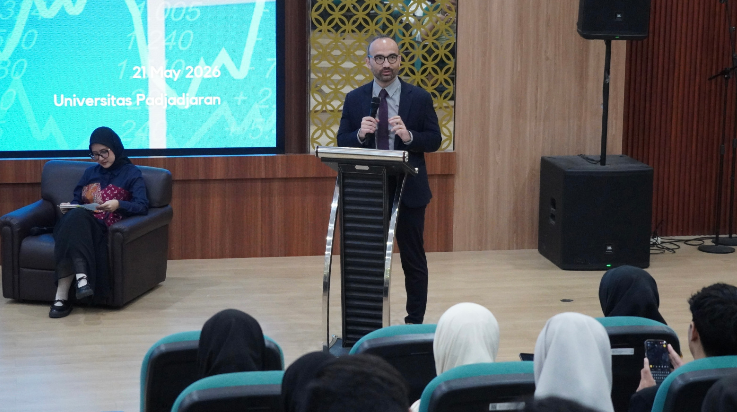
In order to expand the global academic horizon, the Islamic Economics study program, FEB UNPAD successfully held a book discussion event with a world financial sociology expert, Dr. Ryan Calder, on Thursday (21/5).
Dr. Ryan Calder, who is the Head of the Department of Islamic Studies at Johns Hopkins University, United States, was present in person to dissect his latest scientific work in front of lecturers, researchers, and hundreds of students.
The event was officially opened by Prof. Fahmi as the Dean of FEB UNPAD. After the opening, the event continued with a keynote speech session delivered by Prof. Dian Masyita, Ph.D as a Professor in the Field of Islamic Economics and Finance UNPAD
In her keynote speech, Prof. Dian explored the track record of in-depth research that has been carried out by Dr. Calder as a sociologist who focuses on the field of Islamic finance.
“The presence of Dr. Ryan Calder brings a new color to our academic climate. The sociological research methodology that he uses will enrich the development of Islamic economics and finance in a different perspective, which may be more often seen only from the point of view of law or pure economics,” said Prof. Dian in his presentation.
Entering the main event, a discussion of paradoxes in Islamic finance presented by sociologist Ryan Calder, Head of the Department of Islamic Studies at John Hopkins University who researched why this industry is growing so rapidly even though its products often mimic the economic effects of interest or usury. Through global asset growth data and geographic reach, Calder highlights the crucial role of sharia scholars as a figure who bridges religious principles with the needs of modern capitalism. The author of The Paradox of Islamic Finance compares the loss of the ban on interest in the Christian and Jewish traditions with the survival of the tradition in Islam thanks to the existence of religious jurists who continue to play an active role. These experts carry out the functions of preservation, legitimacy, justification, and restriction to ensure that financial transactions remain considered religious by the wider community. In conclusion, the commercial success of this sector depends heavily on the ability of scholars to accommodate contemporary business practices without removing the red lines of Islamic law.
The book review event was closed with a souvenir presentation session to Dr. Ryan Calder as a form of appreciation and commitment to strengthening international research collaboration in the future